
Sintered Stone vs Quartz for Singapore Kitchens
Key Takeaways
Sintered stone is made by using intense heat and pressure to sinter mineral particles into a dense surface, while engineered quartz uses quartz minerals, pigment and resin binders.
Both materials offer strong durability and stain resistance, but their response to high heat is different.
The right countertop depends on how you cook, clean, use your kitchen and, yes, how you want the finished space to look.
Samples help, but viewing the actual slab is particularly useful when colour, veining, texture and the position of cut-outs matter.
Introduction
Choosing a kitchen surface sounds simple until you actually start comparing materials. Then come the questions. Will it scratch? What happens when curry spills? Can it cope with a hot pan? And will that beautiful sample still look right across an entire countertop?
For many Singapore homeowners, choosing between sintered stone vs quartz comes down to these everyday questions.
Getting solid, low-maintenance countertops is easy with either choice, yet their factory origins vary completely. Sintered stone packs natural minerals down deep, using heavy heat to bake the particles into a dense slab. Engineered quartz blends quartz minerals together with resin, pigment, and other compounds. That manufacturing process variance dictates your heat resistance, maintenance, and daily kitchen use.
Granite and other natural stone options remain part of the conversation too. So rather than treating this as a simple head-to-head, it helps to understand what happens beneath the surface first. At our Woodlands showroom, you can compare both side by side, from Gardenia and Dekton sintered stone to Quartzose, Caesarstone and Silestone quartz.
Understanding Sintered Stone
What is Sintered Stone and How is it Made?
Sintered stone is an engineered surface produced primarily from mineral materials. During manufacturing, these materials are prepared, compacted and exposed to very high temperatures. This process allows the particles to sinter, creating a dense finished surface.
Put simply, manufacturers take carefully prepared natural minerals, press them together, then sinter them. The goal of the sinter process is to create a hard, compact slab without relying on the type of polymer resin binder commonly associated with engineered quartz.
Sintering bonds the particles through heat rather than holding them together with resin. Manufacturers control how the minerals sinter, how the slab forms and how the finished surface is treated.
Technical specifications vary by product, so performance should always be checked against the particular surface being considered. As one recent example, 2024 technical data for a 12 mm sintered product reported average water absorption of 0.022% for one tested specification.
Key Features of Sintered Stone
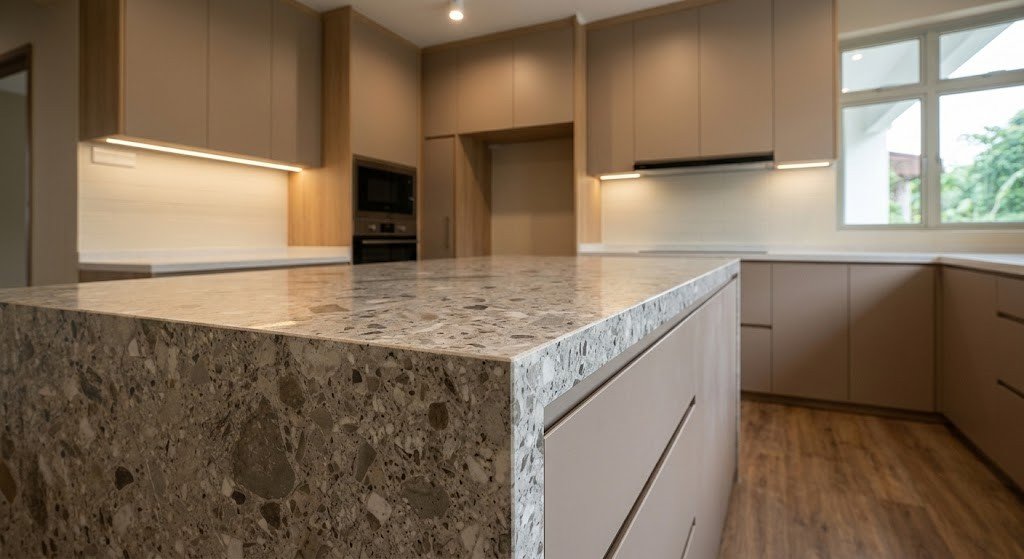
The tight structure formed by sintering gives sintered stone heaps of practical benefits.
In a bustling kitchen, you get solid protection against daily stains, scratches, and decent heat tolerance. Since creation involves baking the material under intense heat, sintered stone handles hot zones exceptionally well.
That does not mean normal care goes out the window. Scratch-resistant isn't scratch-proof, and a hard surface can still chip if an edge takes a heavy knock.
Edges, corners, sink holes, and hob cut-outs remain prone to heavy blows. Quality fabrication counts because even a tough slab requires proper handling, support, and fitting.
For routine wiping, the non-porous finish on many sintered stone pieces keeps spills manageable. Coffee, tea, sauces, oil, and vibrant foodstuff should still be wiped instead of leaving them on the surface. Good habits may sound dull, but they work.
Quartz Countertops Explained
What is Engineered Quartz?
Quartz counters are factory-built rather than cut straight out of solid natural stone blocks.
Manufacturers combine quartz minerals with polymer resin, pigment, and other additives. Resin binders serve to glue everything tightly, while pigments shape diverse hues and designs. Safety data from a specific engineered quartz line notes polyester resin making up 5% to 17% by weight, though exact formulas change by item and shade.
This explains why engineered quartz must never get mixed up with natural quartz or quartzite. The finished countertop is manufactured from a controlled mixture.
Unlike a system applying high heat to fuse mineral particles into sintered stone, quartz relies on a binding agent. Factories blend elements, shape the mix, and cure it into slabs. Modern production can achieve remarkably uniform marble, concrete, and granite looks.
Durability and Maintenance of Quartz Countertops
Quartz sees high demand since routine maintenance is dead easy to manage.
The top finish remains mostly non-porous, handles stains effectively, and resists scratch marks throughout standard home activities. Modern cleaning tips point toward using warm water alongside mild detergent for regular wipe-downs, plus clearing liquid spills promptly rather than letting them sit.
However, building in scratch resistance does not mean it is entirely scratch-proof. Always deploy a cutting board instead of slicing directly on quartz countertops, and exercise caution with heavy cookware plus sharp tools.
Heat requires extra caution. Given that engineered quartz features resin, producers suggest setting hot cooking vessels onto trivets or thermal pads. High heat along with sudden temperature shifts can harm the surface, particularly affecting the resin element.
Treat the material as a hardworking countertop rather than an indestructible workbench.
Aesthetic Appeal of Quartz Countertops
One of quartz's biggest design advantages is control.
Because quartz is engineered, it comes in a wide range of colours, finishes and veining. Visuals can imitate marble, granite, and broader natural stone options while retaining heightened pattern uniformity across multiple zones.
This regularity comes in handy whenever you want the layout across a large kitchen to follow a cohesive design theme.
Sintered Stone vs Quartz: Key Differences
Manufacturing Process Comparison
When making sintered stone, factories compact raw minerals and subject them to extreme heat. Heat and pressure transform the blended elements into a finished piece. The minerals sinter together, and the sinter process creates the dense surface.
Quartz follows another route. Instead of using thermal energy to bind particles into the slab, producers mix quartz alongside resin binders, pigment, plus other ingredients. The resin acts as the binder.
So when comparing sintered stone and quartz, think fused mineral structure versus resin-bound engineered material. It is a small manufacturing distinction with practical consequences, especially around high heat.
Stain Resistance and Maintenance
Each surface is engineered for simple daily maintenance, performing well when ordinary kitchen spills happen.
Sintered stone records tiny water absorption levels during testing, so liquids stay on the surface rather than soaking in. Quartz is similarly non-porous and usually needs no periodic sealing.
When facing coffee, tea, curry, oil, or sauces, the golden rule remains unchanged: clean up the mess right away.
Quartz also calls for caution with chemical cleaners. Current recommendations point out that harsh or abrasive solutions can damage the top coat or resin component, making gentle cleaning methods the smarter daily option.
Scratch Resistance and Durability
Both materials offer strong scratch resistance, but no countertop should be treated carelessly.
Sintered stone gets its dense structure when manufacturers sinter mineral particles at high temperatures. This helps create a surface resistant to scratches and everyday wear.
Quartz also performs well against routine scratches. However, current care guidance still recommends cutting boards because sharp objects can leave marks.
There is another distinction worth remembering: scratch resistance and chip resistance are not the same thing.
A hard surface can resist a knife yet still suffer damage when a heavy object strikes an exposed edge. This matters especially around sinks, corners and cut-outs in both sintered stone and quartz. Use cutting boards, avoid dragging heavy appliances and handle cookware with care.
Choosing the Right Countertop for Your Kitchen
Factors to Consider When Selecting Countertops
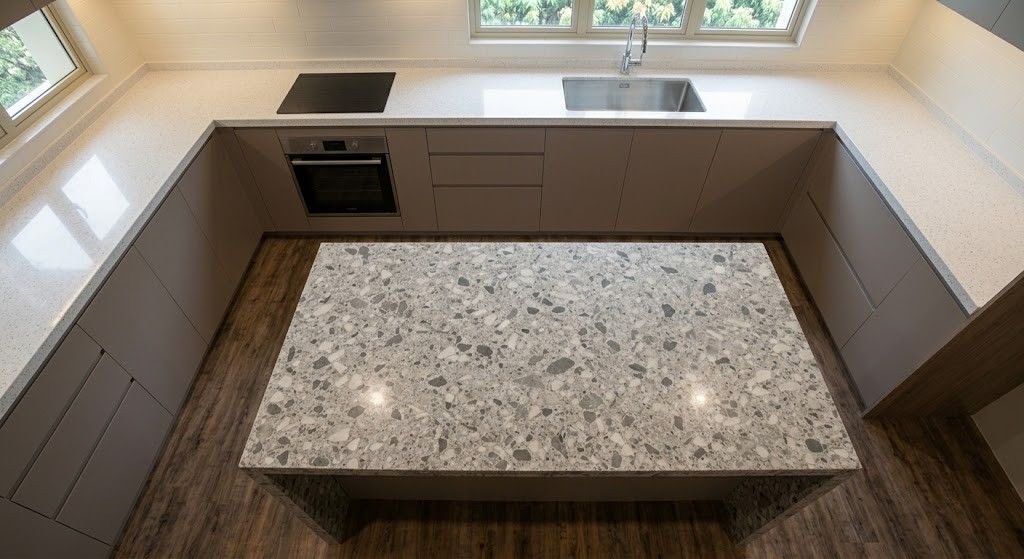
Start with the way you actually use your kitchen.
If you cook frequently and regularly handle hot cookware, compare the heat resistance of each material and the manufacturer's care requirements. If spills are the bigger concern, look at stain resistance and cleaning instructions.
Then consider fabrication. Where will the sink go? How many cut-outs are required? What edge profile do you want? How will the slab be supported?
Granite brings total unpredictability compared to engineered quartz. Real earth gives every piece random veining, whereas quartz locks in steady patterns. Sintered stone can feature marble- or granite-inspired designs printed onto the surface or created within the slab.
Just pick whatever makes cooking and maintenance easiest for your home. Bellus fabricates both materials in-house at our 60,000 sqft Woodlands facility, with our teams handling measurement, fabrication and installation.
Design Options and Aesthetic Appeal
Choosing designs is merely step one.
Study the veining, texture, finish, slab dimensions, and edge details closely. A dramatic marble-style vein can present a totally different visual impact on a complete kitchen counter than on a small tile piece.
This holds true for sintered stone as well. With manufacturers pressing mineral elements into large formats featuring managed layouts, the end product spans from understated surfaces to vivid marble patterns.
Quartz brings similar design flexibility via natural minerals, pigment, and resin. Where matching patterns across multiple areas is a priority, engineered quartz keeps things cohesive.
Granite and other natural stones offer one-of-a-kind variety. For many households, that irregularity is the biggest selling point.
Final Thoughts on Sintered Stone vs Quartz
The right countertop depends on what matters most to you.
Sintered stone offers strong heat and stain resistance. Quartz is easy to clean and offers more consistent patterns, but needs protection from hot cookware. Both have non-porous surfaces that make everyday spills easy to manage.
If you prefer natural variations in colour and pattern, granite is another option to consider.
Think about how you use your kitchen, the look you like and how much maintenance you’re comfortable with.
Frequently Asked Question
-
It comes down to priorities. Sintered stone stands up to heat and scratches, while quartz offers reliable durability and low maintenance.
-
Cost varies by brand, slab size, thickness, design, edge profile and fabrication requirements. Compare complete installed quotations rather than material price alone.
-
Both are designed as durable countertop materials. Actual lifespan depends on the product, fabrication, installation, usage and care, so check the specific manufacturer's warranty and technical information.
-
It is useful, especially when the design has strong veining, movement or texture. A small sample may not show how the full slab will look.
-
Check colour, veining, finish, texture and thickness. Also ask about stain resistance, scratch resistance, heat precautions, fabrication requirements, warranty and recommended cleaning.
See Sintered Stone & Quartz in Person
Compare colours, textures, finishes, and countertop options at Bellus's showroom before deciding which surface suits your kitchen.